Blog Details
☆ From Blog
Blog Details
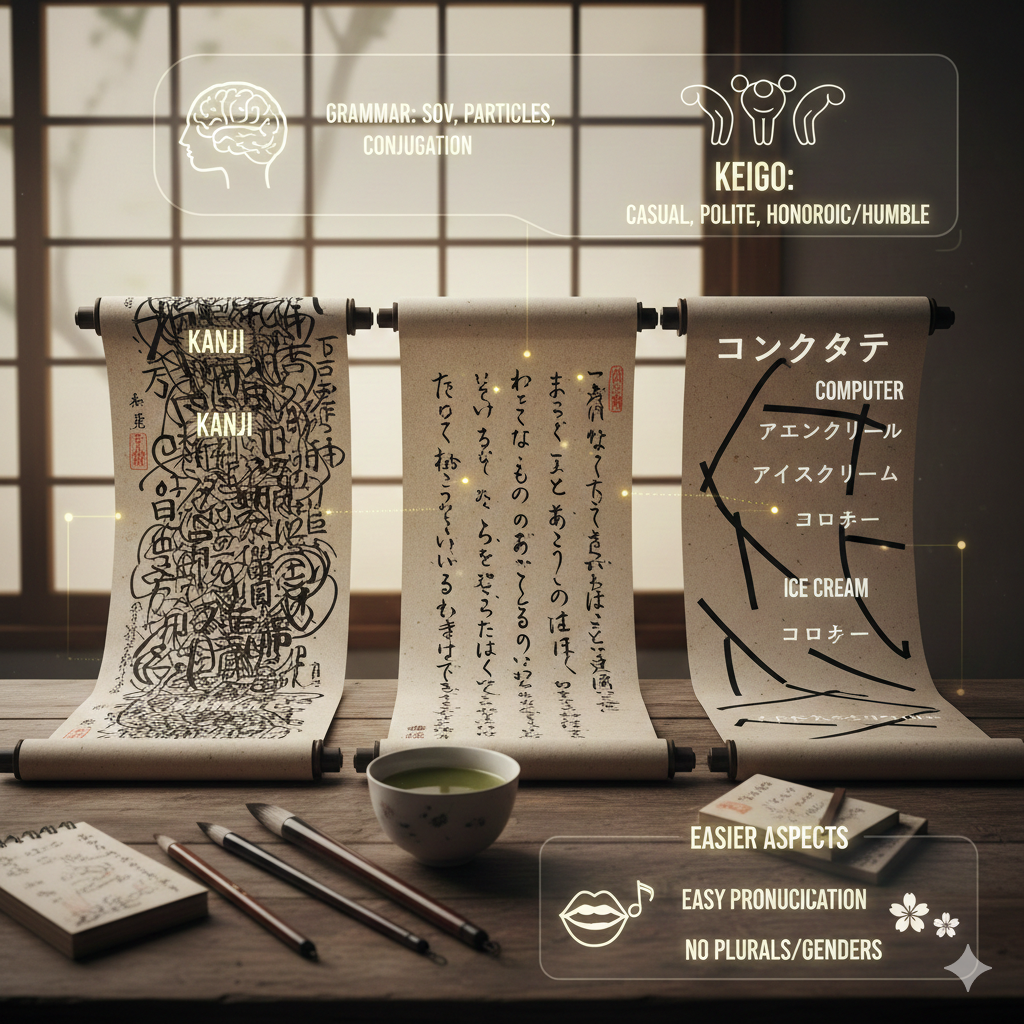
How Hard is the Japanese Language?
Learning Japanese can be challenging at first, but it is definitely achievable with persistence. The U.S. Foreign Service Institute (FSI) typically classifies Japanese as a Category IV language, meaning it is one of the more difficult languages for native English speakers to learn and reach professional working proficiency.
Here are the main reasons why Japanese is considered difficult:
1. The Writing System (The Biggest Hurdle) 🤯
This is often cited as the single most challenging aspect of the language. Japanese uses three distinct writing systems concurrently:
- Hiragana: A phonetic alphabet of 46 basic characters used primarily for grammatical particles and native Japanese words.
- Katakana: A phonetic alphabet of 46 basic characters used mainly for foreign loan words (e.g., computer, ice cream) and emphasis.
- Kanji: Characters borrowed from Chinese, where each character represents a concept or idea (e.g., man, tree, water). You need to learn thousands of Kanji to be proficient in daily life.
The constant need to use all three systems makes reading and writing complex.
2. Grammar (Particles and Conjugation) 🧠
While basic sentence structure might feel intuitive to some (it's similar to Nepali, Subject-Object-Verb), the details are tricky:
- Particles: The language relies heavily on small particles ($wa$, $ga$, $o$, $ni$, $de$, etc.) which follow a word to mark its grammatical function (subject, object, location, etc.). Using these correctly takes a lot of practice.
- Verb Conjugation: Verbs change their form based on tense, negativity, and especially the level of politeness required.
3. Levels of Politeness (Keigo) 🙏
The social context of a conversation heavily dictates the language used. This system, called Keigo, has three main levels:
- Casual ($Futs\bar{u}go$): Used with friends and family.
- Polite ($Teineigo$): Used with strangers or social equals.
- Honorific and Humble ($Sonkeigo$ and $Kenj\bar{o}go$): Special vocabulary and verb forms used when talking to or about superiors, customers, or elders to show respect and humility.
Mastering $Keigo$ requires not just memorization, but a deep understanding of Japanese social hierarchy.
✅ The Upside (Easier Aspects)
Japanese also has some features that are simpler than other languages:
- Pronunciation: Pronunciation is relatively easy to master. Unlike Mandarin Chinese, it is not a tonal language, and most sounds are straightforward for English speakers.
- Plurals and Genders: Nouns do not have grammatical gender, and there are no regular plural forms for nouns, which simplifies vocabulary learning.
In summary, Japanese is considered hard primarily due to the massive initial hurdle of the three-part writing system and the complexity of the politeness system ($Keigo$).
Recent Blogs
🇯🇵जापानी भाषा सिकौँ, जापान जाने सपना साकार पारौँ! 🌸
January 25, 2026

How Curry Day is celebrated in Japan like this
January 22, 2026

Are you preparing to go to Japan on a Student Visa or SSW Visa? If you are looking for high-quality Japanese language classes, look no further!
January 21, 2026

Here are the key strengths and positive aspects of Sabi Education Group
January 20, 2026
Services
Working Hours
- Sunday: 7 AM to 5 PM
- Monday: 7 AM to 5 PM
- Tuesday: 7 AM to 5 PM
- Wednesday: 7 AM to 5 PM
- Thursday: 7 AM to 5 PM
- Friday: 7 AM to 5 PM
Contact Us
OFFICE :
- Bharatpur
- Ratnanagar
Copyright © 2025 Sabi Education Group. All rights reserved
Powered by Dipesh Chaudhary