Blog Details
☆ From Blog
Blog Details
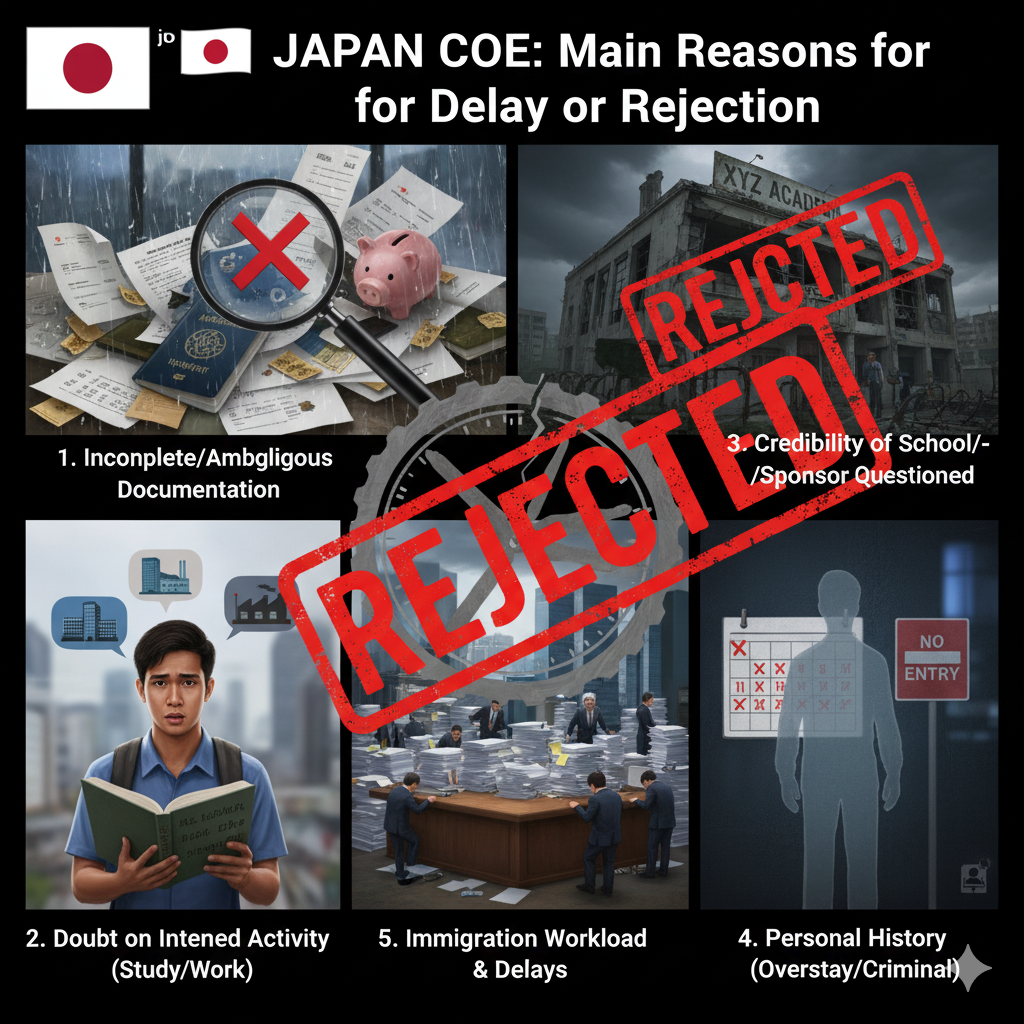
Japan COE: Main Reasons for Delay or Rejection
1. Incomplete or Ambiguous Documentation
This is the most common reason for issues.
- Missing Documents: Failure to submit all required documents (educational certificates, financial statements, employment proof, etc.).
- Discrepancies or Errors: Mistakes in the documents (e.g., date of birth, name, academic details) or conflicting information between different documents.
- Financial Insufficiency: The financial means of the applicant or the sponsor (if applicable) are deemed insufficient or the proof is unclear.
2. Doubts Regarding the Purpose of Entry
If the Japanese Immigration has doubts about the applicant's true intent, the COE may be rejected.
- Study Visa: If the applicant's profile (long study gap, inadequate Japanese language skills) does not align with the stated educational goal.
- Work Visa: If the job description provided by the company does not match the applicant's qualifications or experience.
- Genuine Intent: If Immigration suspects that the applicant's primary goal is not the stated activity (study/work) but merely residing in Japan.
3. Credibility of the Sponsor or Institution
The history and reliability of the sponsoring organization (Japanese language school or employer) can impact the decision.
- School/Company Record: If a school or company has a poor track record, such as a high number of students/employees who have violated visa rules (e.g., overstayed), the applications for new applicants may face stricter scrutiny.
- Company Status: If the employing company is new, financially unstable, or has had issues with foreign workers in the past.
4. Applicant's Personal Background and History
The applicant's past activities can negatively affect the outcome.
- Previous Visa Violations: If the applicant has previously violated Japanese visa regulations, overstayed, or been deported from Japan.
- Criminal Record: Having any past criminal history.
5. Immigration Processing Load (Usually for Delay, Not Rejection)
This is a common cause for delay in the process.
- High Volume of Applications: During peak seasons (like before the April academic intake), the sheer number of applications causes longer processing times.
- Additional Investigation: Delay can occur if Immigration finds discrepancies and requires the sponsor or company to submit additional documents for clarification or if they conduct a direct investigation.
Recent Blogs

🇯🇵जापानी भाषा सिकौँ, जापान जाने सपना साकार पारौँ! 🌸
January 25, 2026

How Curry Day is celebrated in Japan like this
January 22, 2026
Are you preparing to go to Japan on a Student Visa or SSW Visa? If you are looking for high-quality Japanese language classes, look no further!
January 21, 2026

Here are the key strengths and positive aspects of Sabi Education Group
January 20, 2026
Services
Working Hours
- Sunday: 7 AM to 5 PM
- Monday: 7 AM to 5 PM
- Tuesday: 7 AM to 5 PM
- Wednesday: 7 AM to 5 PM
- Thursday: 7 AM to 5 PM
- Friday: 7 AM to 5 PM
Contact Us
OFFICE :
- Bharatpur
- Ratnanagar
Copyright © 2025 Sabi Education Group. All rights reserved
Powered by Dipesh Chaudhary