Blog Details
☆ From Blog
Blog Details

The Best Hiragana & Katakana Learning Resources
Hiragana and katakana are literally the ABCs of Japanese. They're the most basic types of Japanese characters and essential parts of the Japanese language. Learning these two types of characters is often the very first step to learning Japanese, too.
Being able to read hiragana and katakana is amazing because it's such an immediately practical skill. You see them everywhere in Japan. The scenery of Japan, or even your neighborhood Asian grocery store may start to look different once you know hiragana and katakana.
Luckily, they're fairly easy to master, too. No, you don't need a photographic memory or superpower to memorize all of them. All you need is the right method and tools to study effectively and efficiently.
There are 46 hiragana characters for hiragana and katakana respectively. Memorizing 92 characters with unfamiliar shapes might sound intimidating now, but trust me. People have learned them in a couple weeks, a few days, or even a few hours with these effective methods.
If you want to study hiragana and katakana fairly quickly, and never forget them, you've come to the right place. I'll talk about how you can do it, and introduce some of the best kana learning resources you can use for a successful kana learning experience.
- How To Learn Hiragana & Katakana
- 1. Use memory hints aka "mnemonics"
- 2. Prioritize "reading" over "writing"
- 3. Practice recalling
- The Best Resources for Learning Hiragana/Katakana
- Tofugu's Learn Hiragana/Katakana Books
- HIRAGANA/KATAKANA Memory Hint
- Learn Languages with Dr. Moku (Hiragana & Katakana)
- Learn ALL Hiragana/Katakana in 1 Hour - How to Write and Read Japanese (JapanesePod101.com)
- For Extra Quiz Practice and Reviews
- Tofugu's Learn Kana Quiz
- Real Kana
How To Learn Hiragana & Katakana
First, let me go through the three key points for successful kana learning.
1. Use memory hints aka "mnemonics"
Memory hints, aka mnemonics, are honestly the game changer in remembering foreign characters like hiragana, katakana, and even kanji. Using mnemonics, you can easily associate the shape of kana with the reading. Curious how mnemonics actually work? Here's an example to remember hiragana "ki" (き). This one is pretty simple. Just think of a key! 🔑
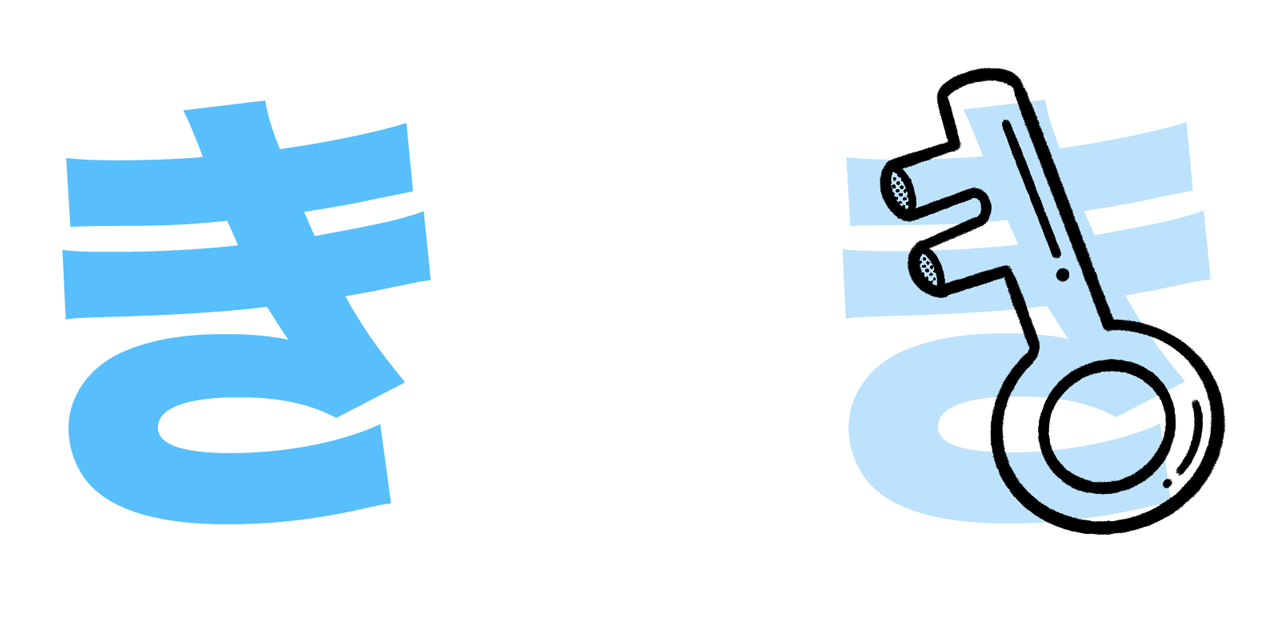
Remembering a bunch of unfamiliar shapes suddenly sounds doable, right? Mnemonics make things easy to remember, recall, and not forget. It really is a powerful tool for kana learning.
2. Prioritize "reading" over "writing"
Focus on reading first. Not writing. I know, it's not the traditional way children learn their characters. But, learning to read is more important as the most common form of "writing" nowadays is typing. (If you can read kana, you can type them.)
Being able to handwrite hiragana from memory is a great skill to have too, but it takes a lot more time to master and has fewer real-life benefits. I recommend you save it for later. Handwriting or tracing over the characters with your fingers can be a great way to spend time observing the shapes closely, but always keep in mind the "reading" priority rather than being able to handwrite from your memory. At least, for now.
3. Practice recalling
Once you become familiar with the kana, practice reading repeatedly. Make sure to review items you've learned and keep it up. And when you review, focus on your recall. The more effort you put into recalling something, the stronger memory your brain will end up building.
The Best Resources for Learning Hiragana/Katakana
So now that we've talked about the three key points for successful kana learning, you may be thinking, "What tools can I use to learn hiragana and katakana?"
I got you — I put together a list of some of the best kana learning resources. They, of course, have small differences, but they all feature mnemonics and reading practice, which are the key points for successful kana learning
🥇 1. Tofugu's Hiragana & Katakana Guides (Free, Web)
📍 https://www.tofugu.com/japanese/
- Why it's great: Best mnemonics and clear explanations.
- Use it for: Learning kana from scratch with memorable visuals.
🥈 Kana (Ben Humphreys) (iOS App)
📱 App Store: Search "Kana Ben Humphreys"
- Why it's great: Clean design, practice by writing and recognition.
- Use it for: Drilling and reviewing kana quickly.
🥉 Anki with “Kana” Deck (Free, Multi-platform)
🌐 https://apps.ankiweb.net/
- Why it's great: Uses spaced repetition (SRS) to maximize memory.
- Use it for: Long-term retention and daily review.
🏅 Hiragana & Katakana Memory Hint (Japan Foundation) (iOS/Android)
📱 App Store / Google Play: Search “Hiragana Memory Hint”
- Why it's great: Uses cute illustrations and mnemonics.
- Use it for: Visual learning and fun reinforcement.
🎖 RealKana (Web quiz tool)
🌐 https://realkana.com/
- Why it's great: Quick, customizable kana quizzes.
- Use it for: Speed drills and testing recognition.
Recent Blogs
🇯🇵जापानी भाषा सिकौँ, जापान जाने सपना साकार पारौँ! 🌸
January 25, 2026

How Curry Day is celebrated in Japan like this
January 22, 2026

Are you preparing to go to Japan on a Student Visa or SSW Visa? If you are looking for high-quality Japanese language classes, look no further!
January 21, 2026

Here are the key strengths and positive aspects of Sabi Education Group
January 20, 2026
Services
Working Hours
- Sunday: 7 AM to 5 PM
- Monday: 7 AM to 5 PM
- Tuesday: 7 AM to 5 PM
- Wednesday: 7 AM to 5 PM
- Thursday: 7 AM to 5 PM
- Friday: 7 AM to 5 PM
Contact Us
OFFICE :
- Bharatpur
- Ratnanagar
Copyright © 2025 Sabi Education Group. All rights reserved
Powered by Dipesh Chaudhary